Agentic AI vs GenAI: 2026 Marketing Automation ROI
Introduction
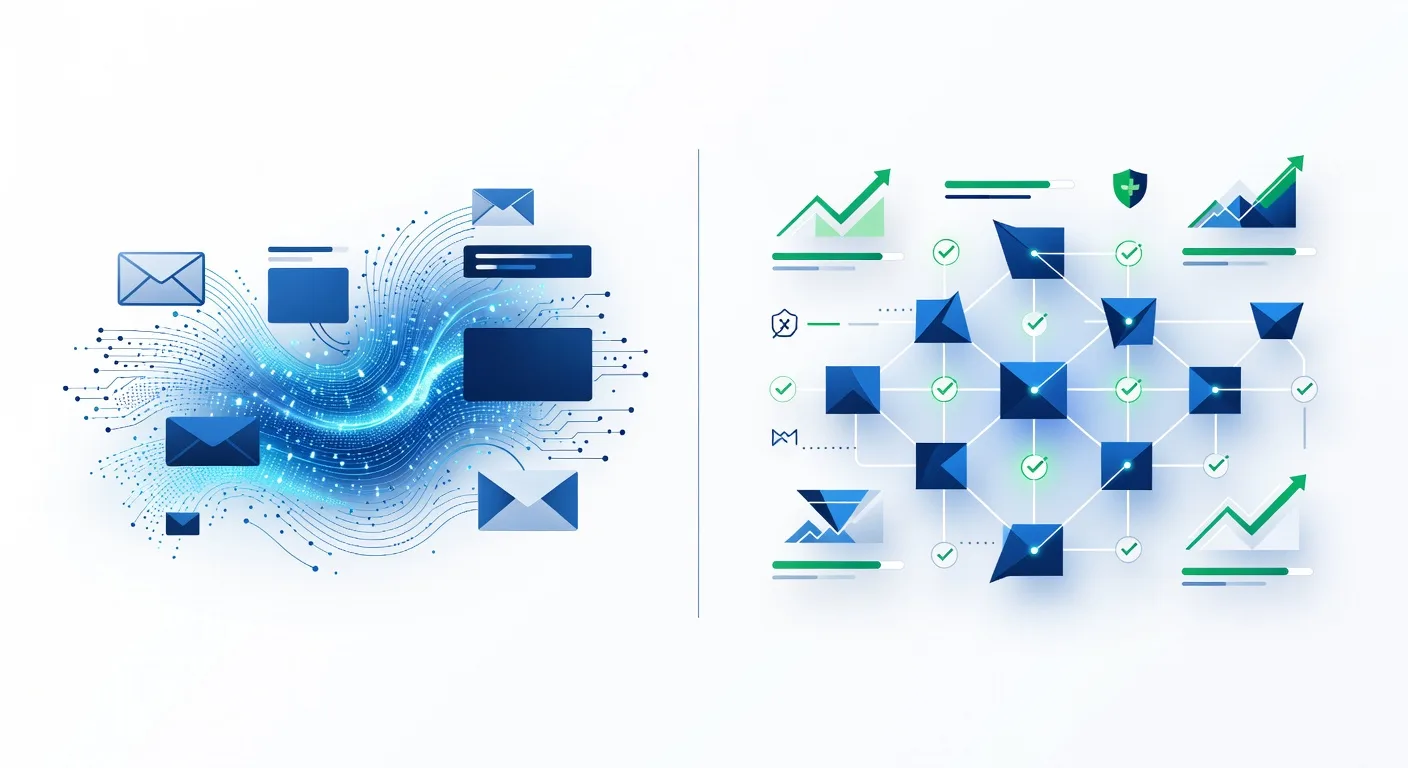
Marketing automation is entering a new phase in 2026. Generative AI still turns prompts into copy or images, but agentic AI goes further: it accepts an outcome, breaks it into steps, and executes across tools under human guardrails. The result is speed plus accountability.
This piece clarifies what each style does, the tasks agentic AI can run end to end, the risks to manage, and how to model ROI without hand‑wavy math. You will leave with a practical checklist to deploy safely.
Agentic AI vs GenAI, plainly
- GenAI: single-shot creators. You prompt; it drafts emails, ads, captions, or product copy.
- Agentic AI: goal-seeking operators. You set a goal; the agent plans, calls tools, checks results, and loops until done.
In 2026, teams are moving from API calls and manual prompting to workflow‑embedded agents. Your role shifts from crafting prompts to governing policies, access, and quality. Platforms let you perfect one task, then thread tasks into reusable automations.
2026 tasks across the journey
Think in threaded workflows, not isolated prompts.
- Brief‑to‑publish
- Generate a creative brief, align to brand voice, assemble assets, run approvals, publish, and track. A design agent can pull scene files from a 3D library, render variants, and attach alt text before handoff. If you maintain product scenes, keep them current via our 3D model catalog.
- Lead nurture and SDR handoff
- Qualify, enrich, write sequences, schedule sends, and escalate hot replies to humans. Agentic systems personalize at scale and never forget follow‑ups.
- Product launch orchestration
- Build the GTM plan, spin landing pages, coordinate paid budgets, localize posts, and monitor lift. Perfect the localization task first; then thread it with budget optimization.
- Commerce content pipelines
- Sync PIM data, auto-generate SKU pages, render 3D views, and push to marketplaces. Agents can update renders when specs change, drawing from the free 3D model library to stay consistent.
- Always‑on optimization
- Test creative, adjust bids, refresh segments, and roll back when quality drops. Human reviewers approve exceptions; the agent keeps the routine humming.
ROI in 2026: what improves and how to prove it
Scaled programs beat pilots. Integrated agentic stacks report measurable lift because they connect data, teams, and governance.
- Benchmarks: Agentic AI adoption is surging, with market growth above 40% CAGR. Companies report average returns around the 171% range, higher in the U.S. Targeted agentic workflows often deliver 4.1x–5.3x ROI. B2B teams see ~5x conversion improvements, ~35% ROMI uplift in six months, ~22% lower CPA, and ~40% faster recognition of winning initiatives.
- Time and quality: Cycle time compresses from weeks to days; error rates and brand drift drop as checks are codified. Output consistency rises because every run follows the same playbook.
- How to measure: Define success upfront. Track incremental lift versus holdouts, run MMM for channel allocation, and use multi-touch attribution for near‑term guidance. Include agent run‑costs, human oversight hours, and downstream rework avoided.
Risks and governance you cannot skip
Agentic AI brings autonomy—and responsibility.
- Failure patterns: About 29% of deployments are abandoned within 90 days. Top causes include unclear success criteria, poor tool or data access, and brand‑voice drift. All three are fixable with disciplined scoping and controls.
- Compliance: If you operate in the EU or serve EU residents, autonomous agents must meet EU AI Act obligations by August 2026. High‑risk functions face stricter Chapter III requirements. Replace black boxes with auditable traces and clear accountability.
- Controls that work: Effective 2026 marketing governance spans seven layers: schema checks, marketing-logic rules, consent enforcement, adaptive access, rich audit trails, agent‑specific controls, and continuous monitoring. Tie responsibilities to a living RACI aligned with widely used risk frameworks. For agents, require an append‑only trail for every tool call: who, what tool, input hash, auth decision, and outcome—retained for review.
Implementation blueprint: from tasks to threads
Start small, but build like you intend to scale.
- Map the process
- Use process mining or simple journey maps to spot handoffs, SLAs, and data dependencies beyond “content productivity.”
- Hardening a single task
- Pick a scoped task with clear acceptance criteria. Add guardrails, tests, and observability until failure rates are acceptable.
- Threading tasks
- Compose hardened tasks into an agentic workflow. Reuse shared skills (e.g., scheduling or translation) across departments.
- Human‑in‑the‑loop by design
- Define when humans review, approve, and override. Separate who writes policies, who operates agents, who reviews outputs, and who audits results.
- Operate and improve
- Monitor KPIs, drift, and incident rates. Capture learnings into policies and tests. Expand only when the previous thread is stable.
Tip: Asset‑led pipelines benefit quickly. If your catalog includes 3D scenes, wire agents to refresh renders as specs change, keeping PDPs current via our downloadable 3D assets.
Quick Checklist
- Write success metrics and guardrails before a single prompt
- Secure tool and data access; verify consent and least privilege
- Stand up observability: traces, logs, and evaluation tests
- Pilot one task; freeze scope until quality is stable
- Add RACI with named owners, reviewers, and escalation paths
- Record append‑only audit trails for every agent tool call
- Validate ROI with lift tests, MMM, and attribution
- Document rollback procedures and safe‑stop triggers
FAQ
What’s the core difference between GenAI and agentic AI?
GenAI creates content from prompts. Agentic AI pursues a goal, plans steps, and operates tools to finish work, with humans setting policies and overseeing outcomes.
Where should marketers start in 2026?
Pick a single, high‑leverage task in a known workflow—like localization QA or SDR triage. Perfect it, then thread it into a brief‑to‑publish or nurture pipeline.
How do we avoid brand safety issues and hallucinations?
Encode rules as checks, not slide decks. Use schema validation, approved term lists, and pre‑launch reviews. Maintain auditable traces for every decision.
Will this replace our current automation?
Often it augments it. Mature stacks blend existing rules engines with agents for fuzzy, creative, or exception‑heavy steps while preserving governance.
Does this help product content and 3D workflows?
Yes. Agents can sync PIM data, regenerate renders, and publish updates from a consistent 3D asset source so visual content stays accurate.
Conclusion
Agentic AI is the step‑c
Sources
- Agentic AI for marketing teams - WRITER
- Agentic AI Orchestration in 2026: Automating Workflows at Scale
- Top Agentic AI Trends to Watch in 2026 - CloudKeeper
- 39 Agentic AI Statistics Every GTM Leader Should Know in 2026
- Artificial Intelligence Statistics: Your Marketing ROI Roadmap For 2026 | Zigment AI
- AI Marketing Statistics 2026: 200+ Adoption Insights - Digital Applied
- EU AI Act Compliance for Autonomous AI Agents in 2026 - Covasant
- Nestr blog - A Deep Dive in the European AI Act: What it Means for Your Organization
- How AI Agents Are Governed Under the EU AI Act - The Future Society
- AI Agents vs. Traditional Automation: Best Fit in 2026 - Magazine | Wadline
- Agentic AI for Business Workflows 2026 | Involve Digital
- Agentic AI vs Generative: The 2026 B2B Sales Shift - Landbase
Ready to Get Started?
Explore production-ready 3D models for your next project. Browse the 3D model catalog to download assets you can use right away.
Turn this workflow into real deliverables
Browse production-ready 3D models for your next project, then step into 3d modeling if you need a custom build.