Automation ROI in 2026: Measuring Time Saved vs. Revenue Impact Credib
Introduction
In 2026, automation is no longer a futuristic concept but a core part of marketing operations. Yet, quantifying its return on investment (ROI) remains a challenge for many brand managers and marketing professionals. How do you credibly measure the time saved through automation and translate that into real revenue impact? This guide breaks down practical approaches to evaluate automation ROI without requiring advanced math or deep technical knowledge.
Why Measuring Automation ROI Matters
Automation promises efficiency, reduced errors, and faster workflows. But leadership often asks: "What’s the financial payoff?" Simply counting labor cost savings doesn’t paint the full picture. Automation can unlock capacity, improve quality, and accelerate pipeline velocity — all of which contribute to revenue growth beyond mere cost reduction.
Beyond Cost Savings: The Full Value of Automation
- Time Saved: Automation reduces manual effort and cycle times.
- Error Reduction: Fewer mistakes mean less rework and refunds.
- Capacity Unlocked: Staff can focus on higher-value tasks.
- Revenue Enabled: Faster lead response and campaign execution drive sales.
Understanding these factors helps build a credible ROI narrative that resonates with finance and leadership teams.
Frameworks for Credible ROI Measurement
1. Establish a Clear Baseline
Start by measuring your current manual process. Key metrics include:
- Time per task or transaction
- Error rates and rework costs
- Labor costs and overtime
💡 Looking for professional 3D Product Animation services? Check out our Fiverr gig to get started today!
This baseline serves as your counterfactual — the "what-if" scenario without automation.
2. Quantify Time Savings
Use a formula like:
Time Saved = (Manual Time - Automated Time) × VolumeFor example, if invoicing took 10 minutes manually and 4 minutes automated, and you handle 1,000 invoices monthly, the monthly time saved is 6,000 minutes (100 hours). This freed time can be monetized at your loaded labor rate.
3. Connect Time Saved to Revenue Impact
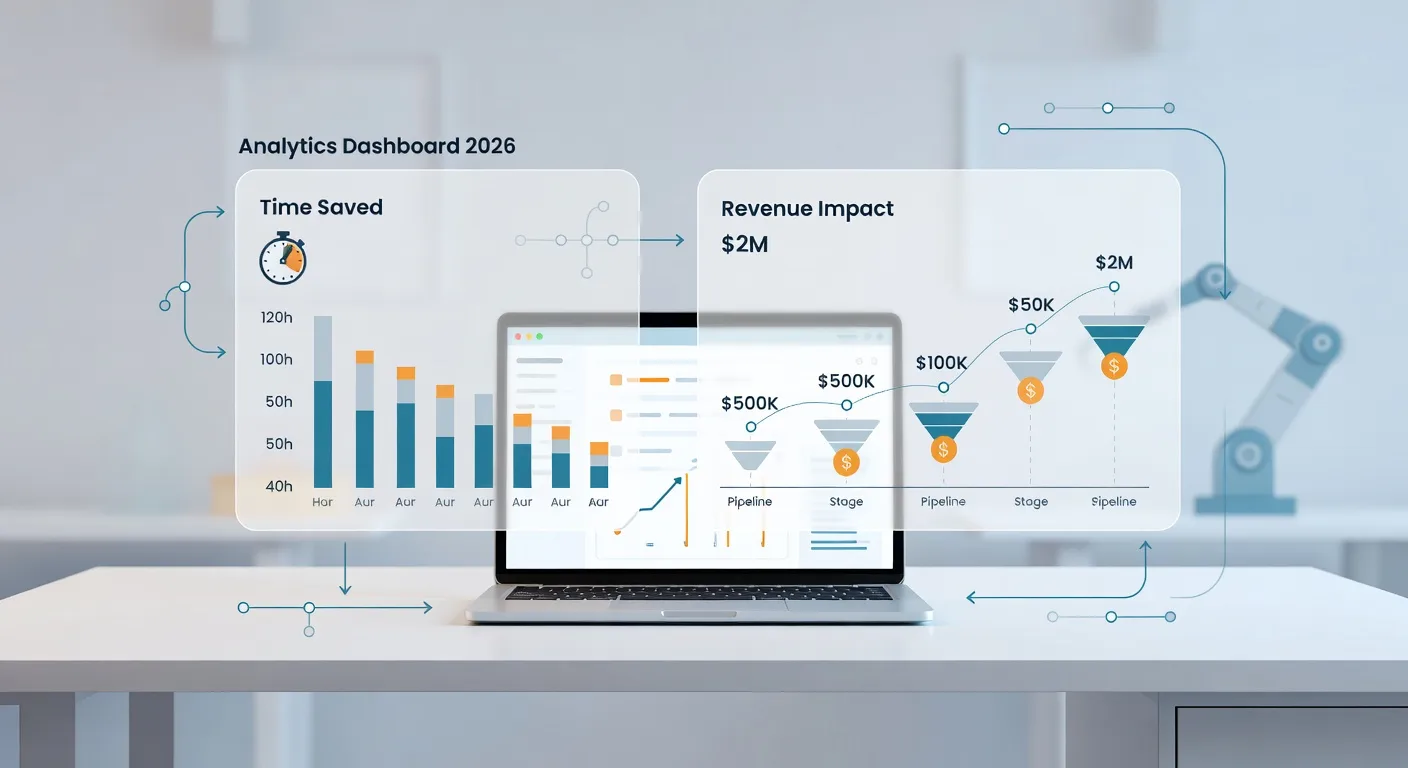
Time savings alone don’t guarantee revenue growth. Link efficiency gains to business outcomes by building a "metric chain":
- Activity metrics (e.g., calls made)
- Conversion metrics (e.g., meetings booked)
- Pipeline metrics (e.g., demos completed)
- Revenue metrics (e.g., deals closed)
Tracking these indicators over time shows how automation-driven velocity improvements influence sales.
4. Include Error Reduction and Quality Improvements
Automation often slashes error rates from 3-5% to under 0.1%. Calculate the cost of errors avoided, including rework, refunds, or compliance penalties. These hard savings strengthen your ROI case.
5. Factor in Capacity and Scalability
Not all time saved translates directly into cost reduction. Sometimes it means handling more volume without hiring. Quantify this capacity unlocked and its potential revenue contribution.
Practical Example: Marketing Automation
Imagine your team automates lead scoring and nurturing. Before automation, it took 5 hours weekly to qualify leads; after, only 1 hour. You save 4 hours weekly.
- At $50/hour loaded labor cost, that’s $200 saved weekly.
- Automation enables quicker follow-ups, increasing conversion rates by 10%, adding $15,000 monthly revenue.
This shows your revenue impact exceeds cost savings, highlighting why measuring both matters.
Automation ROI in Digital Production Workflows
In creative production, tools like AI-powered asset tagging or 3D rendering plugins speed up processes. For instance, automating 3D model optimization can cut rendering time by 60%, enabling faster project delivery and more client work.
Explore how automation integrates with 3D modeling and 3D product animation to boost throughput and quality.
Quick Checklist
- Define baseline metrics for manual workflows
- Measure time saved per automated task
- Calculate error rate reductions and cost avoidance
- Build metric chains linking efficiency to revenue
- Monetize capacity unlocked by automation
- Use dashboards for ongoing tracking and reporting
- Include qualitative benefits like improved customer satisfaction
- Align ROI measurement with overall business goals
FAQ
Q1: Can automation ROI be credible without complex math?
Yes. By focusing on clear, measurable metrics like time saved and error reduction, and connecting these to business outcomes, you can build a strong ROI case without advanced calculations.
Q2: How do I handle indirect benefits like improved customer satisfaction?
Include qualitative feedback and survey data alongside quantitative metrics to provide a holistic ROI picture.
Q3: What if labor costs are low in my region?
Automation ROI still applies through productivity gains, error reduction, and scalability, which affect revenue and capacity, not just labor savings.
Q4: How often should I report on automation ROI?
Establish a regular cadence—monthly or quarterly—using dashboards that track leading and lagging indicators.
Q5: Can automation replace headcount?
Automation amplifies human capability but isn’t solely about headcount reduction. It often frees staff for more strategic work, improving overall productivity.
Conclusion
Measuring automation ROI in 2026 requires a balanced approach that captures both time saved and the revenue impact automation enables. By establishing clear baselines, linking efficiency gains to business outcomes, and including error reduction and capacity benefits, marketing professionals can build credible, actionable ROI narratives. Embrace automation not just as a cost saver but as a growth enabler.
Ready to optimize your digital production workflows and marketing automation? Explore our custom logo animation and website landing page development services to integrate automation seamlessly into your creative pipeline.
Sources
- Marketing Automation ROI: The Ultimate Guide (2026)
- Business Process Automation ROI: Cost Savings & Efficiency Gains in 2026
- Measuring AI Marketing ROI: Complete Framework Guide
- Automation ROI: How to Measure the Value of Test Automation
- Calculate Test Automation ROI – Save Time and Costs
- Calculating The ROI of Automation & Test Management Tools | PractiTest
- The Complete ROI Guide to AI-Powered Finance Automation for CFOs | Peakflo Blog
- Warehouse Automation ROI: How to Calculate Real Financial Impact
- Cloud Contact Center ROI: Complete Calculation Guide & Strategies for 2026
- 10 Metrics to Measure Automation ROI - Latenode Blog
- Automation ROI Beyond Cost Savings: 3 Metrics That Matter - Centelli
- Sales Dashboard Guide: Metrics, Benchmarks & Design (2026)
Ready to Get Started?
If you're looking for professional 3D Product Animation services, I'm here to help! Visit my Fiverr profile to see my portfolio and place an order.
Turn this workflow into real deliverables
Browse production-ready 3D models for your next project, then step into 3d product animation if you need a custom build.