Ecommerce 2026: Tech Shaping Discovery, Search, Checkout
Introduction
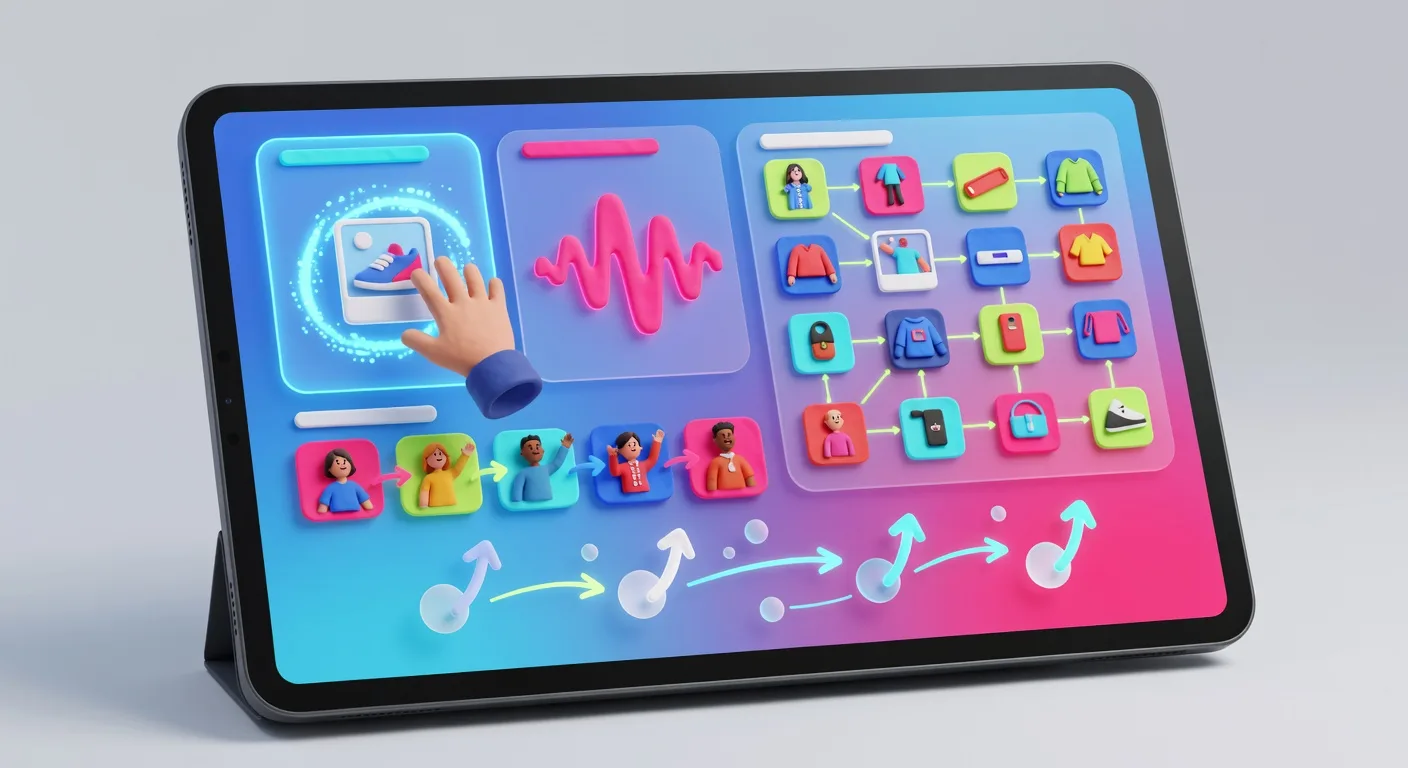
Shoppers in 2026 no longer start with a blank search box. They drag a photo, speak a question, or tap a creator’s video, and the store responds like a helpful guide. Under the hood, new search, recommendation, and payment stacks are rewriting the customer journey. Here’s how discovery, search, and checkout UX are changing—and what marketers can do now.
From search boxes to multimodal shopping copilots
Visual search has moved from novelty to baseline. Shoppers upload a photo or screenshot and instantly see visually similar items, then get suggestions for complementary pieces. This reduces trial‑and‑error typing and speeds the path to a shortlist.
Behind that experience is multimodal retrieval—systems that understand text and images together. In practice, “find a dress like this photo, under $120, in linen” becomes a single query. Tools now let teams tune how much the image vs. text matters, which is powerful for seasonal campaigns.
Infrastructure choices matter. Single‑vector indices can handle around ten million items in tens of gigabytes and are cost‑efficient. Multi‑vector, late‑interaction setups (ColPali‑class) return higher recall at single‑digit terabytes and higher inference cost—worth it when showing the wrong product is expensive.
If your SLO is sub‑100 ms for search‑as‑you‑type, watch query encoding and rescoring, not just the database.
Practical takeaways: start with a simple vector store; only upgrade when traffic and failure costs justify it.
Social discovery becomes the storefront
Social commerce is now a first stop, not a last mile. TikTok Shop surged to $15.8B+ in U.S. sales just a year after its 2023 debut and is projected to reach about $23.4B in 2026. More broadly, global social commerce is estimated at $2.11T this year, with U.S. sales crossing $100B.
The attraction is the native flow: algorithmic discovery, shoppable video, live shopping, and a performance‑driven affiliate marketplace. Content is the ad, the store, and the checkout.
For marketers, treat social like a merchandising surface. Design assets as modular scenes: hero clip, creator cut, stills, and product close‑ups that map to search intent. Bundle offers and complementary items you can swap in real time.
Measure what matters: view‑through to add‑to‑cart, attach rate on bundles, and returns by size or fit claims. A/B test UGC placement and clearer size guides; both are proven levers.
“Complete the look” and smarter recommendations
Recommendation UX is moving from “people also bought” to outfit‑level guidance. Visual understanding helps pair a shirt with matching pants, or a sofa with rugs and lamps, lifting average order value and attach rate.
Tests consistently show opportunity. Sticky Add‑to‑Cart CTAs can lift conversions, and streamlining checkout reduces abandonment. Teams running large volumes of recommendation tests report that small UX and algorithmic tweaks compound.
How to execute without heavy theory: encode your catalog once, store vectors, and run late‑stage reranking for complementary items. Keep a human‑curated fallback for sparse categories. Explain suggestions in plain language to build trust.
For creative teams, prefab 3D packshots and scene renders speed experimentation. Maintain a library of reusable models and textures to assemble cross‑sell panels quickly. If you need starter objects, explore our free 3D model catalog for production‑ready assets.
Frictionless payments: from passkeys to invisible checkout
Checkout UX is compressing to a tap—or disappearing. Invisible or auto‑checkout starts with one‑time enrollment, links a card or wallet, and uses tokenization so payments can complete in the background across apps and stores.
Biometrics are expanding as a secure, consented trigger. Tokenization lets a face or fingerprint authorize existing payment rails and link a single identity to multiple funding sources and loyalty programs. Expect rollouts by ecosystem first, with interoperability improving over time.
In stores, smart shelves, sensors, kiosks, and digital wallets enable checkout‑free moments and bring ecommerce‑grade data into physical retail. The payoff is a consistent, personalized experience across channels that marketers can activate responsibly.
For web checkout, adopt passkeys where available, support dynamic 3‑D Secure when required, and keep progress clear. Default to saved wallets, minimize fields, and let the user finish on the device where they started.
Content ops and 3D pipelines that feed the machine
Search and payments improve only as fast as your content does. Multimodal systems thrive on rich, structured product data and consistent, high‑signal imagery.
Operational moves that compound:
- Standardize titles, taxonomy, and attributes; capture material, fit, and use‑case.
- Generate alt text, FAQs, and care notes from catalog fields; vet with editors.
- Photograph and render consistent angles; include scale and context cues.
- Maintain a vectorized product index; refresh embeddings on inventory change.
- Build a reusable 3D library for PDPs, ads, and “complete the look” blocks; seed it with downloadable 3D models.
Teams using 3D can quickly localize colors, swap props, and stage context for cross‑sells. Use lightweight scene templates so designers and merchandisers can iterate without blocking development.
Quick Checklist
- Audit top queries and add visual search for high‑intent categories
- Pilot multimodal RAG with image weighting; target sub‑200 ms search
- Start simple on vector DBs; upgrade only when error costs justify it
- Ship “complete the look” on key PDPs; A/B test bundles and UGC
- Implement passkeys and wallet defaults; plan biometric enrollment UX
- Instrument attach rate, return‑by‑reason, and conversion to checkout
- Build a reusable 3D model kit and scene presets for rapid creative
FAQ
Do we need a multi‑vector index for product search?
Not always. Single‑vector indices are cheaper and often good enough. Upgrade to late‑interaction, multi‑vector retrieval when the cost of a wrong result, or the scale of your catalog, makes recall the priority.
How fast is “fast enough” for discovery?
Aim for sub‑100 ms for search‑as‑you‑type and fast scrolling. Modern late‑interaction stacks encode the query, prune billions to thousands, and rescore—in tens of milliseconds each—if you cache wisely.
Is biometric checkout safe and private?
Biometric authentication can authorize existing payment tokens without exposing sensitive credentials. Enrollment is consent‑based, and identity can link to funding sources and loyalty without sharing raw biometric data across parties.
Conclusion
The future favors teams who align search, content, and payments. Start small, measure relentlessly, and scale what works. Customers will feel speed before noticing.
Sources
- AI Visual Search in Retail: The 2026 Guide | Endear | Endear Blog
- State of the Art Multimodal RAG 2026 | Ailog RAG
- Multimodal RAG in 2026: Retrieval Over Images, PDFs, and Text
- Invisible Payments: Auto Checkout for Apps & Stores 2026 Guide
- Biometric Payments Are Coming. Here’s Why. - Paravision
- [PDF] Frictionless Payments Enabled by the Internet of Things - Qualcomm
- TikTok Shop's Explosive Growth: 2026 Commerce Trends | Peter V.S. Bond posted on the topic | LinkedIn
- TikTok Shop 2026: The $23B Social Commerce Guide
- 47 Social commerce statistics you need to know in 2026
- 101 A/B testing ideas to improve conversions in 2024 - Optimizely
- A/B Testing Strategies for Recommendations | Constructor
- E-commerce A/B Test Ideas: 2000+ Experiments in 2025
Ready to Get Started?
Explore production-ready 3D models for your next project. Browse the 3D model catalog to download assets you can use right away.
Turn this workflow into real deliverables
Browse production-ready 3D models for your next project, then step into 3d modeling if you need a custom build.